
One Connected View: Why Manufacturers Outgrow Spreadsheets
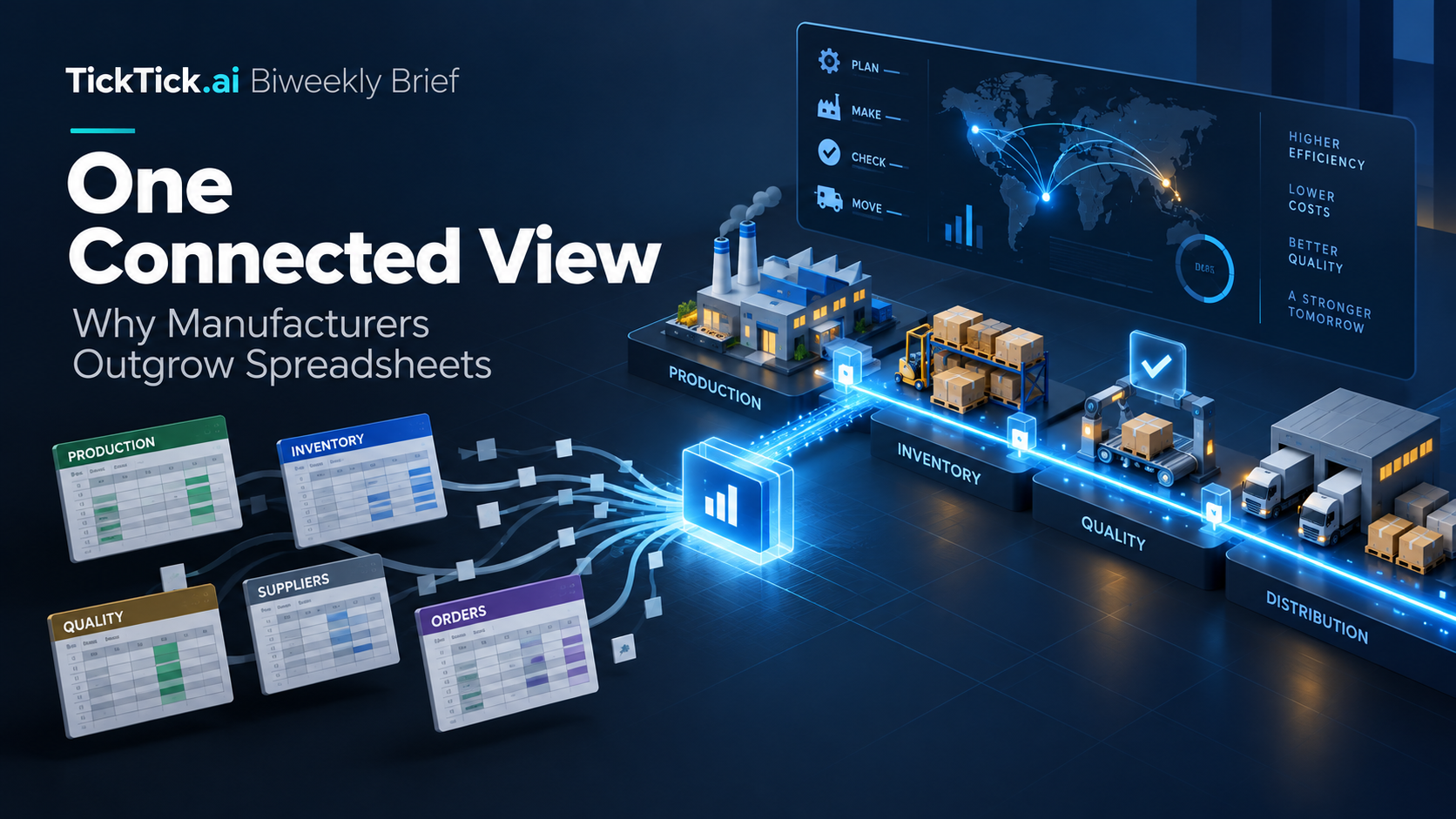
Spreadsheets are excellent tools for analysis. They are much less effective as the operating system for a growing manufacturing business.
As order volume increases, teams often create one sheet for sales, another for purchasing, a third for production planning, and several more for inventory, quality, and dispatch. Each file may be accurate when it is updated. The problem is that the business has no shared version of the truth between updates.
The real cost of disconnected work
The visible problem is duplicate data entry. The larger cost is slower and less reliable decision-making. Sales may promise a delivery date without seeing a material shortage. Purchasing may expedite an item that production no longer needs. Quality teams may hold a batch while dispatch still treats it as available stock.
These gaps create familiar symptoms:
- Frequent production-plan changes and last-minute expediting
- Inventory that exists in the system but cannot be used
- Different answers to the same order-status question
- Manual reconciliation before every review meeting
- Customer updates that depend on calling several departments
None of these is simply a spreadsheet problem. They are signs that processes which now depend on one another are still being managed in isolation.
What “one connected view” actually means
A connected operating model does not mean forcing every employee into one enormous screen. It means that key business events are linked. A confirmed order informs demand. Demand informs material and capacity planning. Production activity updates inventory. Quality decisions change what can be dispatched. Delivery history becomes part of the customer record.
The goal is not more data. The goal is a dependable flow from commercial demand to factory execution and distribution.
For manufacturers evaluating this shift, our manufacturing ERP and production planning overview shows how demand, materials, and production can be brought into one plan.
Four signals that it is time to move
1. The weekly plan is obsolete before the meeting ends
If planners spend most of their time collecting updates, they have less time to evaluate constraints and alternatives. A shared system shortens the information cycle so the plan can reflect what is happening now.
2. Inventory accuracy depends on one person
When only one experienced employee can explain the difference between recorded and usable stock, operational knowledge has become a bottleneck. Availability should reflect reservations, quality status, location, and work in progress—not only a quantity in a cell.
3. Customer commitments are made outside the production picture
A delivery promise is an operational decision. It should account for materials, capacity, current priorities, and dispatch constraints. Connecting quotation and order workflows with production planning makes commitments more realistic.
4. Traceability is assembled after the event
If a customer complaint or audit triggers a search across registers and files, the business is carrying avoidable risk. Our quality management and batch traceability model connects incoming material, production, inspection, and customer feedback.
A practical way to start
Do not begin by digitising every process at once. Start with one flow that creates measurable friction—often order-to-production, material planning, or batch traceability.
- Map the decisions, not just the data fields.
- Identify where information is re-entered or reconciled.
- Define the minimum shared records: customer, item, order, batch, location, and status.
- Choose one operational metric, such as schedule adherence or order-status response time.
- Run a focused rollout, learn, and expand.
This approach turns software implementation into an operating improvement programme. It also gives teams an early result they can see and trust.
The next question
The decision is not whether spreadsheets are useful. They will remain useful. The question is whether the business has grown to the point where spreadsheets should support decisions rather than carry the entire process.
TickTick.ai connects the commercial, factory, quality, inventory, and distribution workflows behind manufacturing and supply-chain businesses. Explore the connected solutions or book a conversation about a phased rollout.
Follow the series: This article is part of the TickTick.ai Biweekly Brief on LinkedIn, where we share practical ideas for connected manufacturing and supply-chain operations twice a month.