
Production Planning Under Volatility: 5 Signals Your Plan Is Failing
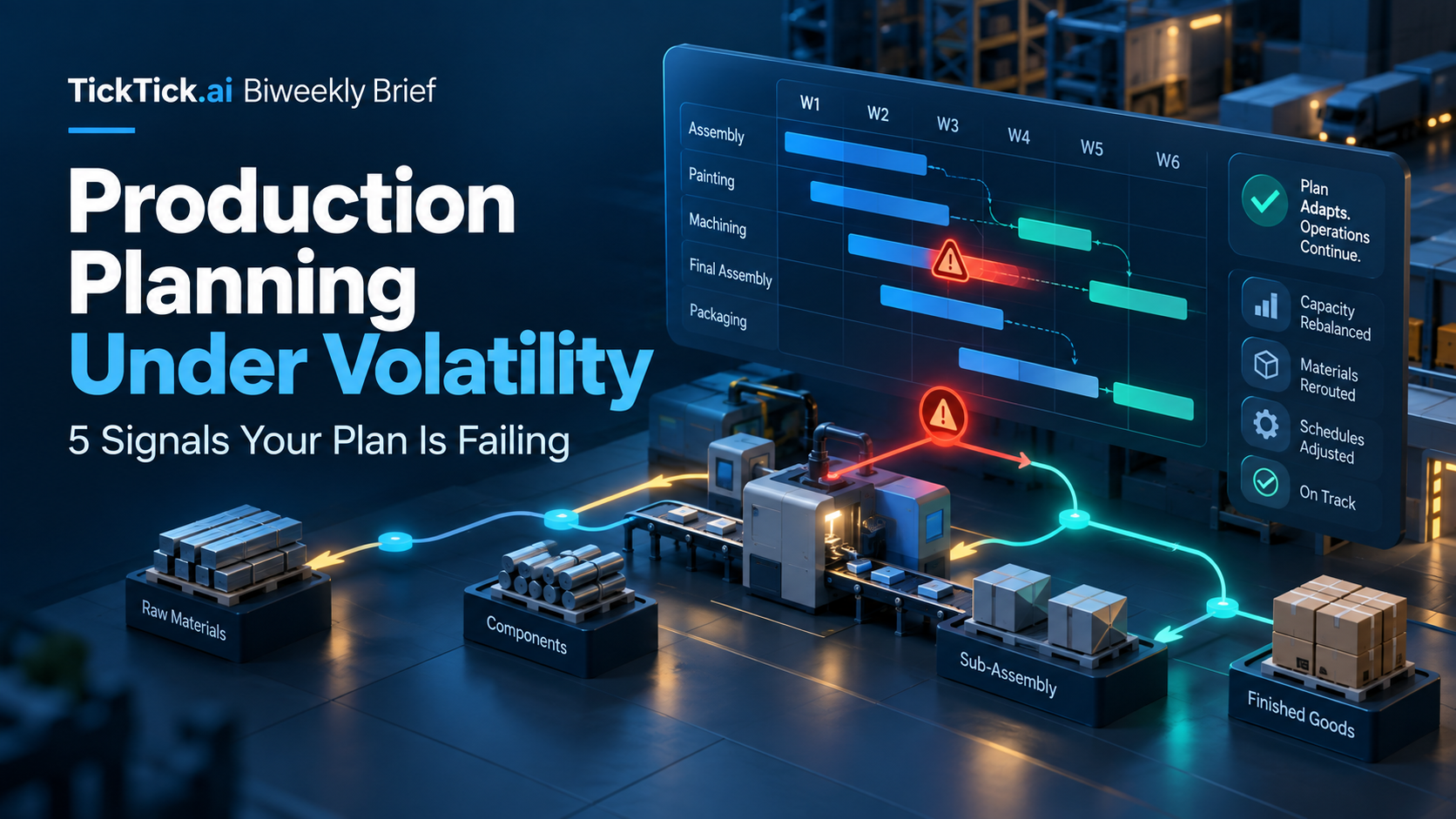
A production plan is useful only while teams believe it. When shortages, urgent orders, machine downtime, or supplier delays arrive, many factories fall back to phone calls, side spreadsheets, and instinct.
Volatility is unavoidable. Planning failure is not. The difference is whether the plan can absorb new information and show the consequences quickly.
Five signals your plan is failing
1. Every urgent order becomes the top priority
When priorities are not linked to customer commitments, materials, and capacity, urgency becomes a negotiation. A reliable plan makes the trade-off visible: which order moves, which resource is constrained, and what customer promise changes.
2. Material shortages are discovered on the shop floor
A shortage that appears only when work begins was visible earlier in the process. Demand, bills of material, available inventory, quality status, purchase orders, and lead times need to be evaluated together.
3. Capacity is measured only in machine hours
Real capacity includes labour skills, tooling, changeovers, maintenance, yield, subcontracting, and inspection. A schedule that ignores these constraints may look feasible while remaining impossible to execute.
4. Work in progress has no reliable status
If planners must walk the floor to know what is complete, the plan is working with stale information. Simple, timely production updates are more valuable than detailed reports entered days later.
5. Schedule adherence is discussed without root causes
A percentage alone does not improve performance. Teams should separate failures caused by materials, capacity, quality, engineering changes, demand changes, and execution. The pattern tells you what to fix.
Build a plan that can change without collapsing
Start with a frozen window for work that should not change without leadership approval. Outside that window, use clear priority rules and scenario comparisons. Connect sales orders to material and capacity requirements, and let every exception retain an owner and reason.
The TickTick.ai manufacturing ERP and production planning model is designed around that connected flow—from demand and purchasing to production and inventory.
A practical weekly rhythm
- Daily: review exceptions, shortages, downtime, and quality holds.
- Weekly: reconcile demand, materials, and finite capacity.
- Monthly: examine adherence losses and recurring constraints.
The objective is not a perfect forecast. It is a plan that responds to reality without losing control.
Explore our connected solutions or book a conversation about a phased planning rollout.
Follow the series: Read the TickTick.ai Biweekly Brief on LinkedIn for practical manufacturing and supply-chain ideas twice a month.